
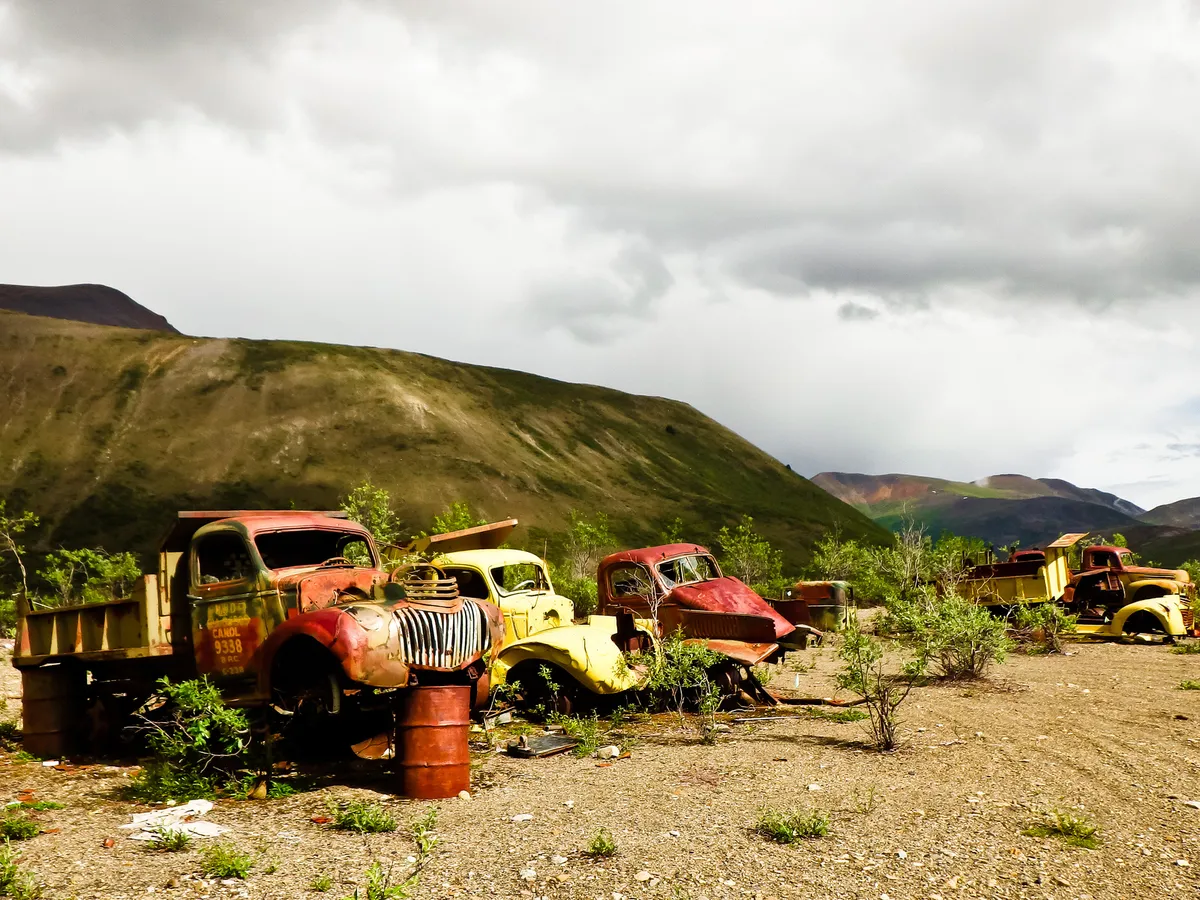
When the United States entered the Second World War, Alaska became an important strategic hub for military operations in the Pacific, and for the transport of U.S.-built war planes to the Soviet Union for use on the eastern front. This required a considerable amount of petroleum that had to be shipped from the U.S. West Coast to Alaska, and the U.S. Army was concerned this shipping route was vulnerable to Japanese air attacks.
The Canol Project was designed to mitigate this project: it involved a building a 2,600km system of pipelines with related roads and telegraph lines from the existing oil field at Norman Wells, NWT to Fairbanks, Alaska, through a remote area that was unmapped and essentially unknown by Europeans. The project was an incredible feat of logistics that involved moving an enormous amount of military and civilian worker, equipment and materials under wartime conditions to an extremely remote area. Workers worked through brutal cold that froze diesel, and horrendous bugs in the summer. They encountered significant challenges building on permafrost and crossing rivers, bogs and mountain ranges. Estimates put the projects’ cost at US $300 million in 1944 dollars.
Despite the enormous cost, the Canol was a failure. By the time it was complete in 1944, the case for the pipeline was debatable, and in 1945, with WWII nearing its end, U.S. Army shut it down because of its high operating costs.
After the war, the U.S. Government had hoped to sell it to the Canadian government or oil companies, but found no buyers for such a remote piece of infrastructure. The pipeline was sold to scrappers, who stripped out everything of value but left pump stations, countless vehicles, equipment, and sections of pipeline on site. While the Yukon portion of the road was rehabilitated to support mining and is open during the summer, the NWT part of the road was left to deteriorate.
Since then the 371-km NWT portion of the Canol service road has become a hiking trail. The Canol Heritage Trail is considered one of the most difficult hiking routes in North America, not because it is technically challenging, but because of its extreme remoteness and multiple wide river crossings. While there has been recent work to remove hazardous waste and old telegraph wires, the old vehicles and equipment have been left on site, relics of an expensive misadventure from WWII.
Related Reads